Another way of solving the reaction at A is by the use of derivative. From
Case No. 2, the deflection at the free end of cantilever beam is
$\delta = \dfrac{Pa^2}{6EI}(3L - a)$
For this problem $P = y \, dx$, $a = L - x$, and $\delta = d \delta_2$.
$d\delta_2 = \dfrac{y\,dx(L-x)^2}{6EI}[ \, 3L - (L - x) \, ]$
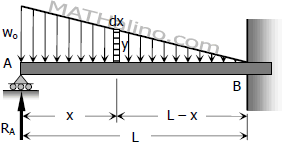 From the figure,
$\dfrac{y}{L - x} = \dfrac{w_o}{L}$
$y = \dfrac{w_o}{L}(L - x)$
Thus,
$d\delta_2 = \dfrac{\left[ \dfrac{w_o}{L}(L - x) \right](L - x)^2}{6EI}[ \, 3L - (L - x) \, ] \, dx$
$d\delta_2 = \dfrac{w_o(L - x)^3}{6L \, EI}[ \, 3L - (L - x) \, ] \, dx$
$d\delta_2 = \dfrac{w_o}{2EI}(L - x)^3 \, dx - \dfrac{w_o}{6L \, EI}(L - x)^4 \, dx$
$\displaystyle \delta_2 = \dfrac{w_o}{2EI} \int_0^L (L - x)^3 \, dx - \dfrac{w_o}{6L \, EI} \int_0^L (L - x)^4 \, dx$
$\delta_1$ = end deflection due to RA
$\delta_1 = \dfrac{R_AL^3}{3EI}$
$\delta_1 = \delta_2$
$\displaystyle \dfrac{R_AL^3}{3EI} = \dfrac{w_o}{2EI} \int_0^L (L - x)^3 \, dx - \dfrac{w_o}{6L \, EI} \int_0^L (L - x)^4 \, dx$
$\displaystyle R_A = \dfrac{3w_o}{2L^3} \int_0^L (L - x)^3 \, dx - \dfrac{w_o}{2L^4} \int_0^L (L - x)^4 \, dx$
$R_A = \dfrac{3w_o}{2L^3} \left[ -\dfrac{(L - x)^4}{4} \right] - \dfrac{w_o}{2L^4} \left[ -\dfrac{(L - x)^5}{5} \right]$
$R_A = -\dfrac{3w_o}{8L^3} \left[ 0^4 - L^4 \right] + \dfrac{w_o}{10L^4} \left[ 0^5 - L^5 \right]$
$R_A = \dfrac{3w_oL}{8} - \dfrac{w_oL}{10}$
$R_A = \dfrac{11w_oL}{40}$ answer