
Derivation of formula for volume of a frustum of pyramid/cone
Tags:
Frustum of a pyramid and frustum of a cone
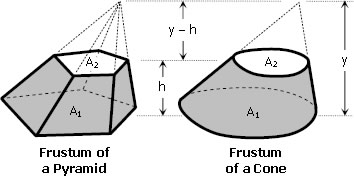
The formula for frustum of a pyramid or frustum of a cone is given by
![$ V = \dfrac{h}{3} \left[ \, A_1 + A_2 + \sqrt{A_1A_2} \, \right] $](/files/tex/013cb4fa5e3e64c8279c56ed6fcc72a39661b3a7.png)
Where:
h = perpendicular distance between A1 and A2 (h is called the altitude of the frustum)
A1 = area of the lower base
A2 = area of the upper base
Note that A1 and A2 are parallel to each other.
Derivation:


→ Equation (1)
By similar solids (Click here for more information about Similar Solids):


Substitute y to Equation (1),![$ V = \frac{1}{3} \, \left[ \, (A_1 - A_2) \left( \dfrac{A_1 + \sqrt{A_1A_2}}{A_1 - A_2}\,h \right) + A_2 h \right] $](/files/tex/0ab9e436dd7f2afca9c4043b3e545a0a3913ce26.png)
![$ V = \frac{1}{3} \, \left[ \, (A_1 + \sqrt{A_1A_2})h + A_2 h \, \right] $](/files/tex/557335ba6f0e76810a4e54f26e2b5bb5c6e942e8.png)
![$ V = \frac{1}{3} \, \left[ \, A_1 + \sqrt{A_1A_2} + A_2 \, \right] \, h $](/files/tex/3339fd5b343705ba18c8e615dacaf90d35670429.png)
![$ V = \dfrac{h}{3} \left[ \, A_1 + A_2 + \sqrt{A_1A_2} \, \right] $](/files/tex/013cb4fa5e3e64c8279c56ed6fcc72a39661b3a7.png)
Comments
Re: Derivation of formula for volume of a frustum
This formula would be correct for frustum of a right circular cone or a pyramid with a base having sides of equal length (e.g., a square base). However, it is erroneous for a frustum with rectangular base. I have not tried for other irregular bases, but for a frustum with a rectangular base the correct formula works out to be:
V = h/3*(L*l + (L*b + B*l)/2 + B*b)
where,
V = volume of the frustum
h = height of the frustum
L, l = length of base and top respectively
B, b = breadth of base and top respectively
Re: Derivation of formula for volume of a frustum
Thank you Panigrahy for sharing your thoughts. The formula derived above is applicable only to 'conical' and 'pyramidal' frustums of any bases (rectangular, irregular curve, regular polygon, irregular polygon, circular, etc.).
I encountered a query before similar to yours; a figure of two rectangular bases. The solid was thought to be a 'frustum of a pyramid' but was actually not. The solid was a portion of a wedge similar to the figure below.
To use the derived formula, make it sure that the solid is a 'frustum of a pyramid' or a 'frustum of a cone'. To determine if it is a frustum of a pyramid or not, extend the lateral edges until they intersect. If they intersects in a single point, it is so, otherwise it is not. The figure below is a frustum of a rectangular pyramid in which the derived formula is always applicable.
I will evaluate the formula you gave if it is indeed for the volume of a frustum of a wedge.
Update:
The formula you gave is for the volume Prismatoid of rectangular bases. The general formula for the volume of prismatoid is
Where
A1 = area of lower base
A2 = area of upper base
Am = Area of the mid-section
L = perpendicular distance between A1 and A2
From the definitions you gave in your formula, the prismatoid formula would be
L = h
A1 = LB
A2 = lb
Am = [(L + l)/2][(B + b)/2]
Substitute the above value to the formula of the prismatoid and arrive the formula you've written.
Re: Derivation of formula for volume of a frustum
Really informative and very interesting!