
Derivation of Pythagorean Theorem
Pythagorean Theorem
In any right triangle, the sum of the square of the two perpendicular sides is equal to the square of the longest side. For a right triangle with legs measures $a$ and $b$ and length of hypotenuse $c$, the theorem can be expressed in the form
Proved by Pythagoras
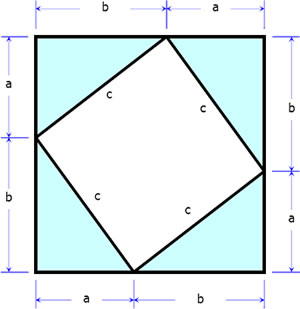
Area of the large square = Area of four triangles + Area of small square
$A_{total} = A_{four \, \, triangles} + A_{small \, \, square}$
$(a + b)^2 = 4 \, \left( \frac{1}{2} ab \right) + c^2$
$a^2 + 2ab + b^2 = 2ab + c^2$
$a^2 + b^2 = c^2$
Proved by Bhaskara
Bhaskara (1114 - 1185) was an Indian mathematician and astronomer.
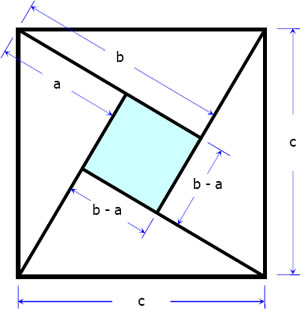
Area of the large square = Area of four triangles + Area of inner (smaller) square
$A_{total} = A_{four \, \, triangles} + A_{small \, \, square}$
$c^2 = 4 \, \left( \frac{1}{2} ab \right) + (b - a)^2$
$c^2 = 2ab + (b^2 - 2ab + a^2)$
$c^2 = 2ab + b^2 - 2ab + a^2$
$c^2 = b^2 + a^2$
Proved by U.S. Pres. James Garfield
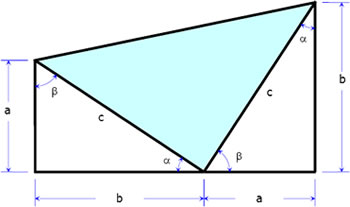
Area of trapezoid = Area of 3 triangles
$\frac{1}{2}(a + b)(a + b) = \frac{1}{2}ab + \frac{1}{2}c^2 + \frac{1}{2}ab$
$(a + b)^2 = ab + c^2 + ab$
$a^2 + 2ab + b^2 = 2ab + c^2$
$a^2 + b^2 = c^2$