Flexure Formula


A D V E R T I S E M E N T


Flexure Formula

Stresses caused by the bending moment are known as flexural or bending stresses. Consider a beam to be loaded as shown.
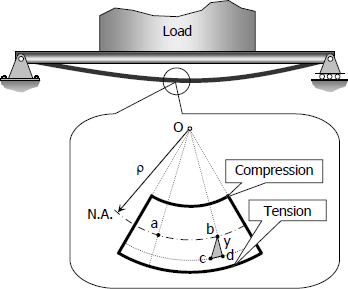
 

Flexure of a beam


Consider a fiber at a distance [math]y[/math] from the neutral axis, because of the beam’s curvature, as the effect of bending moment, the fiber is stretched by an amount of [math]cd[/math]. Since the curvature of the beam is very small, [math]bcd[/math] and [math]Oba[/math] are considered as similar triangles. The strain on this fiber is


\varepsilon = \dfrac{cd}{ab} = \dfrac{y}{\rho}


By Hooke’s law, [math]\varepsilon = \sigma / E[/math], then


\dfrac{\sigma}{E} = \dfrac{y}{\rho}; \,\, \sigma = \dfrac{y}{\rho}E


which means that the stress is proportional to the distance [math]y[/math] from the neutral axis.


For this section, the notation [math]f_b[/math] will be used instead of [math]\sigma[/math].


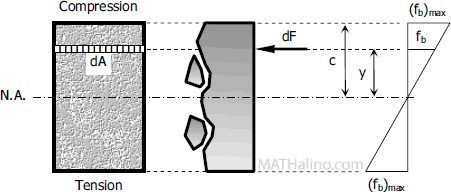
flexure-analysis-in-a-section-of-beam.jpg


Considering a differential area [math]dA[/math] at a distance [math]y[/math] from N.A., the force acting over the area is


dF = f_b \, dA = \dfrac{y}{\rho}E \, dA = \dfrac{E}{\rho}y \, dA


The resultant of all the elemental moment about N.A. must be equal to the bending moment on the section.


[math]\displaystyle M = \int dM = \int y\, dF = \int y \, \left( \frac{E}{\rho}y \, dA \right)[/math]

[math]\displaystyle M = \frac{E}{\rho} \int y^2 \, dA[/math]


but [math]\int y^2 \, dA = I \,\,[/math], then


[math]M = \dfrac{EI}{\rho} \,\, \text{or} \,\, \rho = \dfrac{EI}{M}[/math]


substituting [math]\rho = Ey / f_b[/math]


[math]\dfrac{Ey}{f_b} = \dfrac{EI}{M}[/math]


then


f_b = \dfrac{My}{I}


and


(f_b)_{max} = \dfrac{Mc}{I}


The bending stress due to beams curvature is


[math]f_b = \dfrac{Mc}{I} = \dfrac{\dfrac{EI}{\rho}c}{I}[/math]

f_b = \dfrac{Ec}{\rho}


The beam curvature is:


k = \dfrac{1}{\rho}


where [math]\rho[/math] is the radius of curvature of the beam in mm (in), [math]M[/math] is the bending moment in N·mm (lb·in), [math]f_b[/math] is the flexural stress in MPa (psi), [math]I[/math] is the centroidal moment of inertia in mm4 (in4), and [math]c[/math] is the distance from the neutral axis to the outermost fiber in mm (in).


Page copy protected against web site content infringement by Copyscape

Re: Flexure Formula

Hi many thanks for this formula.

However, there is a mistake on one of the equations, M=|MdF, should read M|ydF.

Re: Flexure Formula

Thank you catching it, I made a correction to it and for easy reference, I copied the erroneous equation below:

\displaystyle M = \int M\, dF = \int y \, \left( \frac{E}{\rho}y \, dA \right)

And this is the correction being made:

\displaystyle M = \int dM = \int y\, dF = \int y \, \left( \frac{E}{\rho}y \, dA \right)

Re: Flexure Formula

are there any other chapters?

Re: Flexure Formula

This site is updated regularly, don't forget to check this site from time to time. What chapter are you looking?

Re: Flexure Formula

you have answers on 3rd edition of singers book...because civil instructors prefer to use the 3rd edition...than of the 4th edition book of pytel and singer....soo hard to find that kind of book though

Re: Flexure Formula

As for now, there is no plan for the 3rd edition of Strength of Materials by Pytel and Singer. I will be spending my energy for the lower subjects to make this site more complete. Maybe I can include that but in the very far future, say 5 to 10 years from now. And it's just maybe. :)

Re: Flexure Formula

Strange, I thought CE instructors use Mechanics of Materials by Pytel and Kiusalaas as textbook. Though I observed that other engineering students (non-CE) use the 4th edition of Singer Pytel, wonder why.