October, 2008

Solution to Problem 203 Stress-strain Diagram

Strength of Materials 4th Edition by Pytel and Singer
Problem 203 page 39

Given:
Material: 14-mm-diameter mild steel rod
Gage length = 50 mm
Test Result:

Load (N) Elongation (mm) Load
(N)
Elongation (mm)
0 0 46 200 1.25
6 310 0.010 52 400 2.50
12 600 0.020 58 500 4.50
18 800 0.030 68 000 7.50
25 100 0.040 59 000 12.5
31 300 0.050 67 800 15.5
37 900 0.060 65 000 20.0
40 100 0.163 65 500 Fracture
41 600 0.433

Required:
Stress-strain diagram, Proportional limit, modulus of elasticity, yield point, ultimate strength, and rupture strength

Axial Deformation

Axial deformation of non-uniform cross-section

In the linear portion of the stress-strain diagram, the tress is proportional to strain and is given by

\sigma = E \varepsilon

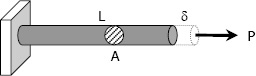
since \sigma = P / A and \varepsilon = \delta / L, then \dfrac{P}{A} = E \dfrac{\delta}{L}

\delta = \dfrac{PL}{AE} = \dfrac{\sigma L}{E}

To use this formula, the load must be axial, the bar must have a uniform cross-sectional area, and the stress must not exceed the proportional limit.

Stress-strain Diagram

Stress-strain diagram of typical structural material

Suppose that a metal specimen be placed in tension-compression-testing machine. As the axial load is gradually increased in increments, the total elongation over the gauge length is measured at each increment of the load and this is continued until failure of the specimen takes place. Knowing the original cross-sectional area and length of the specimen, the normal stress \sigma and the strain \varepsilon can be obtained. The graph of these quantities with the stress \sigma along the y-axis and the strain \varepsilon along the x-axis is called the stress-strain diagram. The stress-strain diagram differs in form for various materials. The diagram shown below is that for a medium-carbon structural steel.

Simple Strain

Also known as unit deformation, strain is the ratio of the change in length caused by the applied force, to the original length.

Simple strain

\varepsilon = \dfrac{\delta}{L}

where \delta is the deformation and L is the original length, thus \varepsilon is dimensionless.

Chapter 2 - Strain

  1. Simple Strain
  2. Stress-Strain Diagram
  3. Axial Deformation
  4. Shearing Deformation
  5. Poisson’s Ratio
  6. Statically Indeterminate Members
  7. Thermal Stress

The World's Largest AC Drive

World's largest AC drive

What is an AC drive anyway?

I am not in the position of explaining to you what is an AC drive. Let me just share to you my layman's view of it. To make it simple, lets take the electric fan at the corner of your room as an example. The one that drives the fan is an AC motor, AC motor is the one responsible of transforming the electrical energy to mechanical energy by electromagnetic induction driving the blades of your electric fan.

AC drives are AC motor speed control systems. It controls the speed of either an induction motor or a synchronous motor by adjusting the frequency of the power supplied to the motor. It also known as...

  • adjustable speed drives (ASD)
  • adjustable frequency drives (AFD)
  • variable frequency drives (VFD)
  • variable speed drives (VSD)
  • frequency converters (FC)